
Finding His Voice on the Trails of Effie Yeaw
Updated: Jun 17
By Debbie Arrington

Jaden Fong found his calling—and his voice—along the trails of the Effie Yeaw Nature Center.
An outdoor educator and award-winning poet, Fong grew up exploring the Nature Center’s oak woodlands and river trails, experiences that would eventually shape both his career and creative life.
“I’ve been going to Effie Yeaw since before I could walk,” Fong recalls. “My mom would take me all the time. Some of my earliest memories are from there.”
He still laughs about watching another preschooler confidently step onto duckweed at the pond near the front entrance while searching for tadpoles. “He went right in the water,” he says. Lesson learned.
As soon as he was old enough, Fong began attending summer camps at the Nature Center. Over time, those childhood experiences evolved into something deeper—a lasting connection to nature and a passion for teaching others.
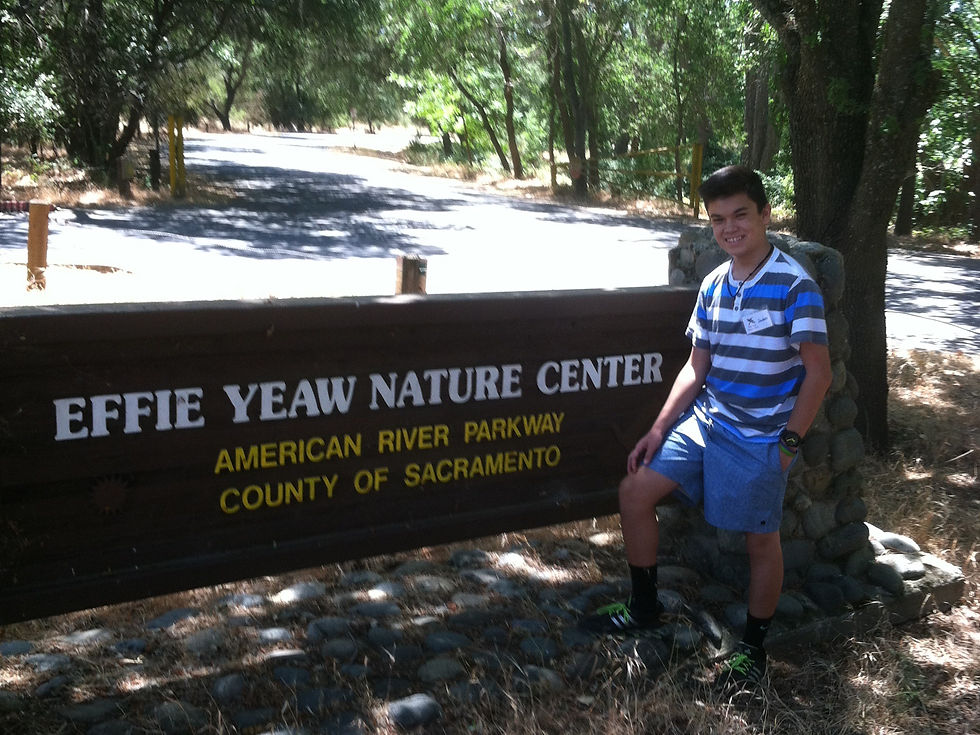
Fong went from camper to camp leader while developing a deep love and respect for the natural world. After studying English, French, and creative writing at Santa Clara University, he received a master's in education at Stanford. Today, he teaches outdoor education—including the humanities side of nature—at Tessellations, a private school in Cupertino.
Now 26, Fong teaches seventh graders not only about nature, but also about journaling and creative writing. He sees the outdoors as a catalyst for personal growth and curiosity—something he discovered at the Effie Yeaw Nature Center.
“Without question, the Nature Center influenced my career choice,” he says. “I’m an outdoor educator because of Effie Yeaw and its staff. They helped me connect with nature, and I wanted to do the same (for other young people).”
In college, Fong explored the relationship between nature, outdoor experiences, and personal well-being. While studying environmental education, he focused on how spending time outdoors helps people think, learn, and grow. “I learned so much when I was outdoors,” he says. “I could figure things out.”
That connection to nature eventually found another outlet: poetry. “Creative writing is one of my favorite things in the world,” he says. “Poetry is my specialization, and my main influence is nature and experiences with nature at Effie Yeaw.”
The Nature Center became even more important during the COVID-19 pandemic. While taking classes remotely, Fong escaped to the trails almost every day.
Surrounded by nature, Fong found a sense of peace, security, and inspiration along the American River. “Effie Yeaw provides such comfort, but also a chance for exploration and freedom,” he notes. “What’s amazing to me: It’s wild, but not daunting. It’s almost meditative.”
He particularly loves the black-tailed deer that roam the Nature Study Area. “I even have a deer tattoo on my forearm. It always felt special to see them.”
That connection eventually inspired his award-winning poem published by the Academy of American Poets, There Will Come a Day When These Deer Trails Will Be My Trails, Until They Will Not Be Anymore.
“One moment was so magical,” Fong recalls. “I plopped myself on the trail and watched deer creep closer and closer. I could almost touch them. It was so moving to have these beautiful animals accept me and investigate me.”
Fong hopes more young people will have similar moments of wonder and connection.
“The trajectory of my life was impacted in a beautiful, positive way,” he says. There must be hundreds—maybe thousands—of others who could have similar experiences. Effie Yeaw is a special place.”
--------------------------------------------------------------
There Will Come a Day When These Deer Trails Will Be My Trails, Until
They Will Not Be Anymore.
By Jaden Fong
Published by The Academy of American Poets
1st Place Winner in the Academy of American Poet’s Tamara Verga Poetry Prize, 2021
There will come a day when the deer trails will be my trails.
And on this day, I will sink my shoes into the dried tar
with bits of rubber sticking to the cracked asphalt like flesh
to the mangled teeth of a starved coyote. The next day
will be filled with electricity—thunder jolting through my ears,
and lightning traveling through the phantom limbs of great oaks,
tingling its boughs with static burn. My children will tell tales
of a single deer that escaped: a speck of debris on the record,
able to be blown away by a stray exhale. They will wonder if
a fawn might wander into an overgrown, pastoral kitchen:
whether its twig legs will stumble over a fallen, moss topped door,
or if its hooves will be plastered in the powder of primeval tile. They will
ask me if I think that a buck might ram its antlers into the glass
of an old Sedan, its breaking crash a crowing of triumph, to which
I will respond that I secretly hope that one of us might be caught
in their headlights, the blush in our eyes extinguished as a branch
peeks through our ribcage. I will tell them that while today the imprints
from our steps etch themselves into the land beneath us, there will
come a day when a pair of hooves will clear the dusty slate one final time.
```


Comments